
Frequently asked questions about Enobot and winery fermentation monitoring
Here you’ll find answers to the most common questions about Enobot, our sensorisation system for real-time fermentation monitoring in wineries — as well as general questions about the wine fermentation process. If your question isn’t here, don’t hesitate to get in touch.
About the product
What is Enobot and how does it work?
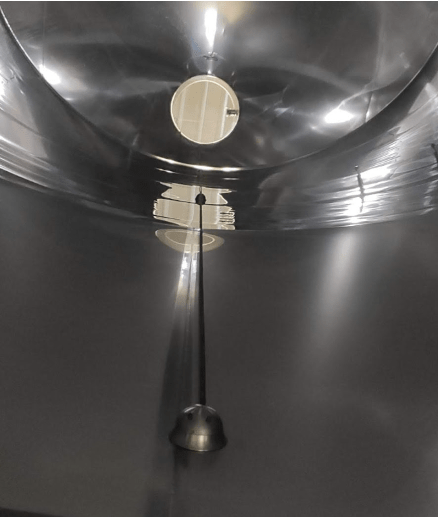
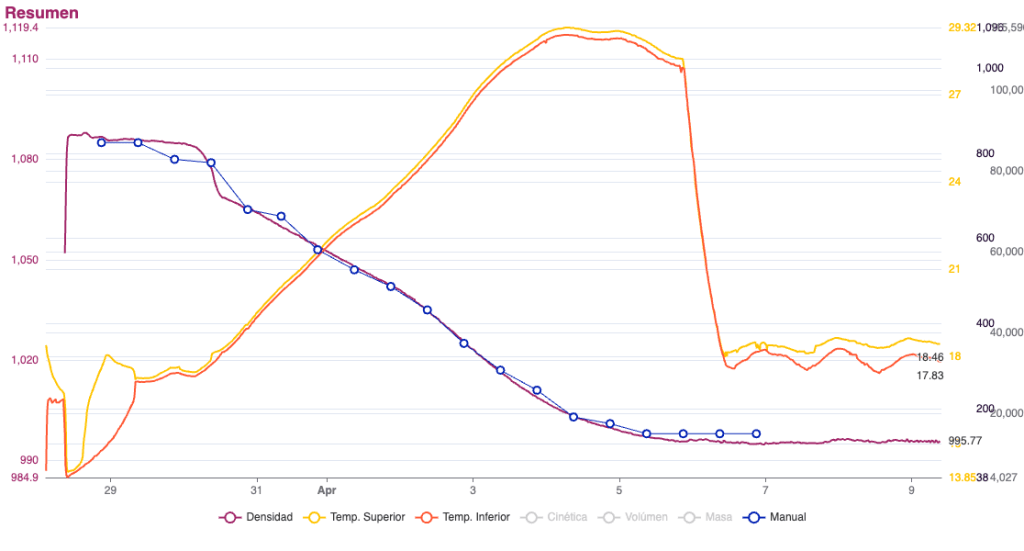
Enobot is a sensing system installed directly in your winery’s fermentation tanks. The sensors measure key parameters in real time — density, temperature and fermentation kinetics (fermentation speed) — and send the data to the Enobot 4.0 platform, hosted in the cloud (AWS).
From the platform — accessible as a web app from any device — the winemaker can follow the evolution of each tank, receive automatic alerts on deviations and consult the history of previous fermentations. The goal is to move from manual, point-in-time control to continuous, objective monitoring.
What parameters does Enobot measure?
Enobot sensors monitor density, temperature and fermentation kinetics in each tank. They also detect events such as stuck fermentations, stratifications, temperature deviations and premature fermentations.
The Enobot Atmo model adds ambient temperature and humidity monitoring of the fermentation hall — useful for wineries that need to control environmental conditions.
Is it compatible with all tank types?
Enobot is compatible with stainless steel, concrete and wood tanks. The size range goes from 5 HL (500 litres) to 5,000 HL (500,000 litres), covering everything from small family wineries to large cooperatives.
Most of our clients work with stainless steel tanks between 10,000 and 50,000 litres. White wine tanks are especially easy to sensorise, as the device installs magnetically without any tank modification.
Is there any risk to the wine from the sensors?
None. Enobot carries IP69 certification — well above the minimum required by European regulation (IP54) and the usual industry standard (IP65-67). This means the sensors are fully protected against high-pressure, high-temperature water, caustic soda and any cleaning product used in a winery.
Installation and setup
How long does installation take?
Installation is fast and non-invasive. On average, each sensor installs in 15–20 minutes per tank. A team can install up to 40 sensors in a single day if the tanks are empty and clean. For installations of more than 50 tanks, the full process takes 2–3 days.
Is any construction or cabling required?
No. Communication between sensors and the platform is wireless via LoRa technology. The only requirements are a power outlet (220V) for the communication hub and an internet connection (4G, WiFi or your winery’s wired network).
Who carries out the installation?
The Enobot team travels to your winery to complete the full installation. During the first few days, we work alongside the winemaker to verify that all data is coherent and the configuration is correct. If any sensor needs replacing, the Enobot team returns to your winery at no additional cost.
What are the steps to get started?
The process is straightforward:
- Confirm the number of tanks, volumes and construction materials.
- Receive a personalised quote by email.
- Sign the contract and share technical documentation on your tanks.
- Component manufacturing (1–5 weeks depending on stock).
- On-site installation (1–2 days with empty, clean tanks).
- Platform verification and go-live.
Costs and return on investment
What is the return on investment?
The estimated saving is €0.50–2 per hectolitre, based on the prevention of incidents such as stratifications and uncontrolled fermentations — derived from our analysis of fermentation failure rates over the past 5–6 years. This represents a return on investment within 1–2 harvests for a mid-sized winery. For larger wineries producing premium wines, the payback can be even faster.
A real example: at a well-known Rueda winery, early detection of a complete stratification in a 450-HL tank prevented a potential loss of €500,000–600,000 (450 HL × ~€10/bottle). Since adopting Enobot, this winery has increased the price of their Chapirete Verdejo by 20% (from €5.50 to €6.80) and their Chapirete Prefiloxérico by 30% (from €9 to €12).
In this article, a leading oenologist from the Rueda region discusses this and other fermentation issues that can have significant economic impact on a winery.
Are there subsidies or tax deductions available?
Yes. Wineries can automatically deduct 15% of any investment in Enobot products — no complex application required.
For R&D projects above €100,000, additional subsidies are available depending on the region. At Komsenso, we have a close relationship with agencies specialising in R&D subsidies who can help wineries through the application process.
Data and platform
Where is data stored?
Fermentation data is collected by the sensors and stored in a dedicated partition for each client on AWS (Amazon Web Services) servers. Clients can access their data directly, export it in bulk, or integrate Enobot with their own systems via API or ModBus.
For wineries that prefer not to share data with the cloud, the Enobot StandAlone model collects and transmits data directly to the winery’s internal systems without passing through external servers.
Does it integrate with my ERP or management system?
Yes. Enobot can integrate with winery management systems via API or ModBus protocol. Integration is adapted to each winery’s specific needs. Note that since each winery uses different systems, personalised integration may require additional development time and cost.
Is it a mobile app or a web application?
Enobot 4.0 is a web application, accessible from any browser and device: desktop, tablet or smartphone. No app installation required.
Support and maintenance
What happens if I have a problem with the system?
All Enobot sensors include technical support and maintenance. Once the contract is signed, winery managers can contact us by email or WhatsApp to resolve any issue. From our experience, virtually all issues are resolved remotely, but if a site visit is needed, the Enobot team travels to your winery.
Can I clean my tanks with the sensors installed?
Yes. Enobot sensors are designed to withstand high-pressure washing and exposure to water, wine and chemical products such as caustic soda. The IP69 certification guarantees that standard tank cleaning and maintenance processes do not affect the sensors.
The sensorisation market
Is this technology a passing trend or is it here to stay?
The wine sector is behind on digitalisation compared to other food industries such as dairy and meat. Currently, only 5–6% of wineries in Spain use continuous sensorisation — compared to 8–10% in France, 10–15% in Chile, 9–12% in Australia and 7–8% in the United States.
Just as refrigeration — which no winery had until the late 1990s — became universal, in the next 10–20 years sensorisation will be a standard in all professional wineries.
Which wineries already use Enobot?
Enobot currently works with more than 30 wineries across several countries and multiple appellations. Wineries such as Uvas Felices, Murillo and Yllera have sensorised their complete facilities. We also work with wineries in collaboration with Vivelys in markets including Argentina, Chile, Canada, the United States and France.