
Interview: María Sevilla on fermentation monitoring, traceability and the future of winery technology
Control, traceability and technology: the vision of an oenological consultant with more than 25 years of experience
About María Sevilla
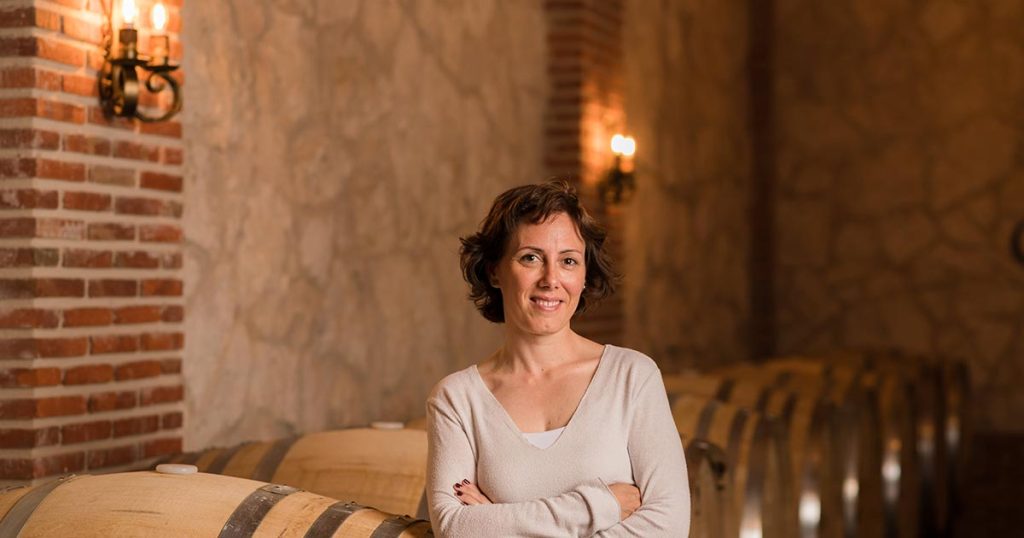
María Sevilla Ruiz is the founder of María Sevilla Asesoría Enológica, one of the leading technical consultancies in Castile and León. Based in Rueda (Valladolid), she works with wineries across multiple appellations, combining physico-chemical analysis, personalised consulting and a clear commitment to technology in oenology.
With more than 25 years of experience, her work is defined by technical rigour and close collaboration with each winery. We had the opportunity to speak with her about the challenges of the harvest, the importance of traceability and the role that sensorisation can play in the future of the sector.
___
Technical challenges
Komsenso: María, thank you for your time. First things first — how was the 2025 harvest, and what are you expecting for 2026?
María Sevilla: The 2025 harvest was devastated by mildew. It hadn’t been this bad in 40 years. There were also extreme weather events — hailstorms and temperatures above 40°C. A very atypical campaign. For 2026, we’ve started with a lot of rainfall and difficulty carrying out winter vineyard work. We’ll see how spring develops and whether the wet weather advances the vegetative cycle too early.
K: How did the difficult conditions affect yield and quality compared to previous years?
M.S.: Last year, significantly. Some vineyards couldn’t be harvested at all — 100% loss. Others were harvested with very low yields. The treatments needed to save the crop have their downstream effects in winery processing. In the winery, we work to minimise the impact on final quality. It will be consumers who judge whether we succeeded.
K: From your position as an external consultant — which gives you a cross-sectional view of many wineries — what technical challenges do you see as most relevant for 2026?
M.S.: I’d say embracing the advances in digitalisation and providing continuous training for winery staff is fundamental — both for achieving quality products and for adapting to markets that are in constant flux.
Traceability
K: Let’s talk about traceability. How is operation logging currently managed in wineries? Has there been progress in digitalising those processes?
M.S.: Most wineries still work with paper documents, which then have to be transcribed according to ISO, IFS, food safety standards and so on. This is a critical pain point: transcription introduces errors, and the time duplication — with multiple people involved — is significant. This is exactly the area that should be digitalised, for efficiency and rigour.
K: You’ve had contact with sensorisation products. What advantages do you see? Are you seeing increased adoption?
M.S.: I recently attended a presentation of these systems. I think it’s an enormous advance. From my experience, you gain time, you have control over deviations, and the information it gives you is extraordinary.
K: Could you share a specific example where data monitoring allowed a problem to be detected in time?
M.S.: Several times we’ve been able to observe how musts that weren’t starting to ferment were stratified. On another occasion, we could see that the cooling system had failed — without even going to the winery. We also detected bubbling in a white must that hadn’t yet been clarified. We’ve spotted errors in winery operations simply by observing kinetic curves and volumes.
Sensorisation
K: Outside Spain, there seems to be greater interest in sensorisation. Do you share that perception? What barriers are slowing adoption in Spanish wineries?
M.S.: Like everything, the high cost is the main barrier. Also, unfamiliarity with these systems among winery technicians — and among owners, a failure to understand the need to invest when things have always been managed “with lower costs,” though that perception is relative. Sometimes we confuse concepts like “traditional,” “organic” or “natural” — wanting to “return to the origin” doesn’t mean going back to the pre-digital era and abandoning technological progress.
Real cases
K: In which winery profiles do you think sensorisation has the most potential?
M.S.: In all of them, in my view. In a small winery where staff are multifunctional, having tools that make their job easier is indispensable for improving product quality and avoiding nasty surprises. In large wineries, even when you have a full team, the technical director needs to have everything under control — to optimise resources and solve problems rather than constantly putting out fires.
K: Have you noticed stricter traceability requirements from international buyers regarding oenological processes?
M.S.: Exports generally require greater traceability control, but they typically don’t do so directly — they require wineries to be certified under international food safety standards, which in turn demand documentation and traceability.
The winery of the future
K: Finally, what would you say to a winery that hasn’t yet adopted sensorisation but is considering it?
M.S.: If you can control your product and minimise setbacks, production costs will decrease — and it may ultimately become a competitive advantage in both quality and cost.
___
From Komsenso, we thank María for her time and her perspective. Her experience confirms what we see every day in the sector: digitalisation and sensorisation don’t replace the winemaker — they give them the tools to make better decisions, faster and with greater confidence.
Learn more: www.komsenso.com/en/enobot-wine-fermentation-monitoring/