
By Komsenso | Real-time fermentation monitoring
Although it might seem that artificial intelligence and robotics belong only to Silicon Valley, the defence industry, or the world’s big tech hubs, 2026 is showing us how artificial intelligence in wine fermentation — and in winemaking more broadly — is arriving in cellars around the world with a force few expected.
In Chile, Viña Concha y Toro, Latin America’s largest wine producer, has spent several years running an AI programme through its Center for Research and Innovation that combines drones and multispectral cameras to forecast harvest volumes — cutting prediction error from the traditional 20–30% down to 2–9%. In Italy, a 2025 study published in Precision Agriculture (Springer Nature) followed two wineries over four years as they adopted UAV-based vigour mapping to plan treatments and guide selective harvesting. In Spain, Bodegas Protos flies drones over 300 hectares of Ribera del Duero, fitted with multispectral and thermal cameras, to assess the state of every vine; in the Ribeira Sacra DO, the PENVITIS+ project — launched in 2026 with €599,238 in funding and the participation of Adegas Moure and the Priorat DOQ Regulatory Council — applies AI algorithms to anticipate pests and disease on steep-slope vineyards. And in Napa Valley, wineries such as Palmaz Vineyards have cut water use by up to 20% using AI-driven irrigation models. An industry once known for resisting technology is learning to trust data — and the results are tangible, on four continents.
And yet there is a striking gap in most of these systems. A process that represents the single most critical transformation in the entire production chain remains, in most wineries, a black box for algorithms: alcoholic fermentation.
AI Already Knows How to Read the Vineyard. Does It Know How to Read the Cellar?
Advances in precision viticulture are real and impressive — and they are no longer confined to any one region. Bodegas Emilio Moro in Pesquera de Duero, Spain, offers a particularly clear illustration: through its Sensing4Farming project, it uses high-resolution satellites (40×40 cm) that generate weekly imagery across its own 200 hectares and a further 800 hectares spread across the Ribera del Duero and Bierzo DOs. From those images it extracts NDVI, ENVI and SAVI indices that measure the vigour and health of every vine, combined with real-time agro-meteorological data — humidity, temperature, soil conductivity — processed through big-data pipelines from bud break to harvest.
Concha y Toro’s experience in Chile points in the same direction at a much larger scale: its CRI has been running its drone-and-AI harvest-forecasting programme since 2018 in partnership with agtech firm Smartdici, with the explicit goal of extending the models from experimental conditions to “a real productive context,” in the words of the centre’s deputy head of R&D, Álvaro González. Meanwhile, the Italian study mentioned above found that UAV-derived vigour maps let growers plan phytosanitary treatments and even harvest selectively block by block — though it also flagged a real barrier: the cost of equipment, software and operator training can be prohibitive for smaller wineries.
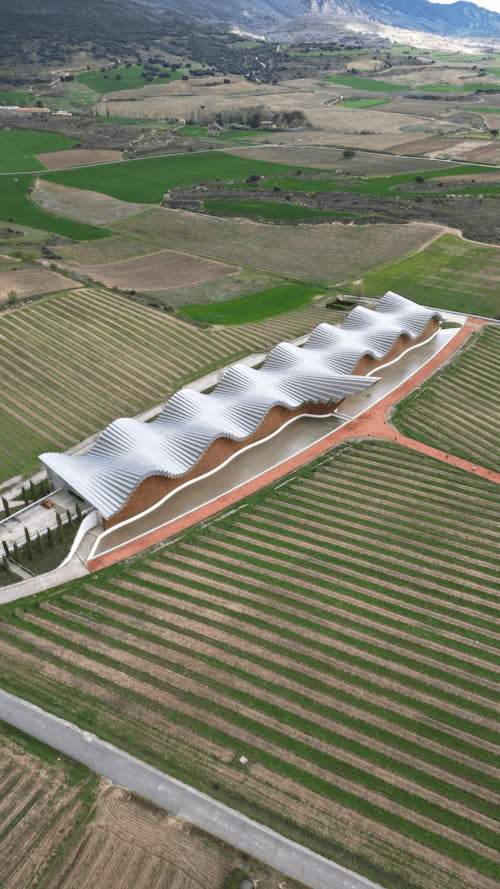
Bodegas Protos adds a relevant nuance: satellite imagery offers a valuable overview, but the winery openly acknowledges that “it wasn’t detailed enough,” which is why it complements satellite data with drones flying at 120 metres, fitted with RGB, multispectral and thermal cameras. The result: AI-generated agronomic recommendations with over 90% reliability in production estimates.
The data feeding these systems is rich, structured and continuous: ambient temperature, accumulated solar radiation, water-stress indices, phenolic ripeness estimated through remote sensing. AI absorbs it well, because it is data that has been recorded, labelled and compared across seasons for years.
But the moment the grapes arrive at the winery and fermentation begins, something happens: the data stream stops. The winemaker takes a density reading in the morning, another in the afternoon. Notes the tank temperature. Logs a visual observation if something looks off. And, in the best case, transcribes those notes into a spreadsheet at the end of the day.
For an AI model, that isn’t a dataset. It’s a skeleton.
What Fermentation Data Actually Reveals
Alcoholic fermentation is the process that turns grapes into wine. And like any complex transformation process, it generates an enormous amount of signal describing exactly what is happening — provided there are instruments capable of capturing it in real time.
The key parameters that a continuous monitoring system records, tank by tank, are:
- Real-time density: the sugar-consumption curve is the fingerprint of every fermentation. Its slope, the speed of its drop, its inflection points, all reveal the metabolic state of the yeast at any given moment.
- Temperature: not as a single reading, but as a continuous time series. Temperature during the first 48 hours of fermentation has a direct influence on the aromatic profile of the resulting wine.
- Fermentative kinetics: the rate at which density evolves — and any abrupt changes — is the earliest indicator of a deviation in progress. A stuck fermentation doesn’t happen suddenly; it has a kinetic signature that precedes the problem by hours.
- Logged levels and events: nutrient additions, temperature corrections, rack-and-returns, pump-overs. The tank’s full operational history, linked to the density reading at every point in time.
This data, recorded continuously and in a structured way by systems such as Enobot, is not simply a management tool for the winemaker. It is, potentially, the most valuable layer of information a winery can contribute to an artificial intelligence model.
The Complete Dataset: Bringing Fermentation Into the Mix
Picture an AI model trained on the kind of data that Emilio Moro or Concha y Toro generate: satellite, drone, soil, climate. It can predict a grape’s potential with notable accuracy. But it cannot answer the question that really matters for a winery’s consistency: why do two vintages with similar grapes produce wines with different profiles?
The answer, almost always, lies in what happened during fermentation.
Once fermentation data is integrated alongside climate, varietal, soil and vineyard data, the model gains a complete view of the cause-and-effect chain:
Early harvest due to extreme heat → high-sugar must → fast fermentation with a thermal peak on day 3 → irregular kinetics on days 5–7 → nutrient addition → resulting aromatic profile X.
This kind of sequence, repeated over several seasons and across multiple tanks, is exactly the type of structured data that machine learning models need to identify what factors determine the properties of each vintage: its tannic structure, its aromatic expression, its acidity, its ageing potential.
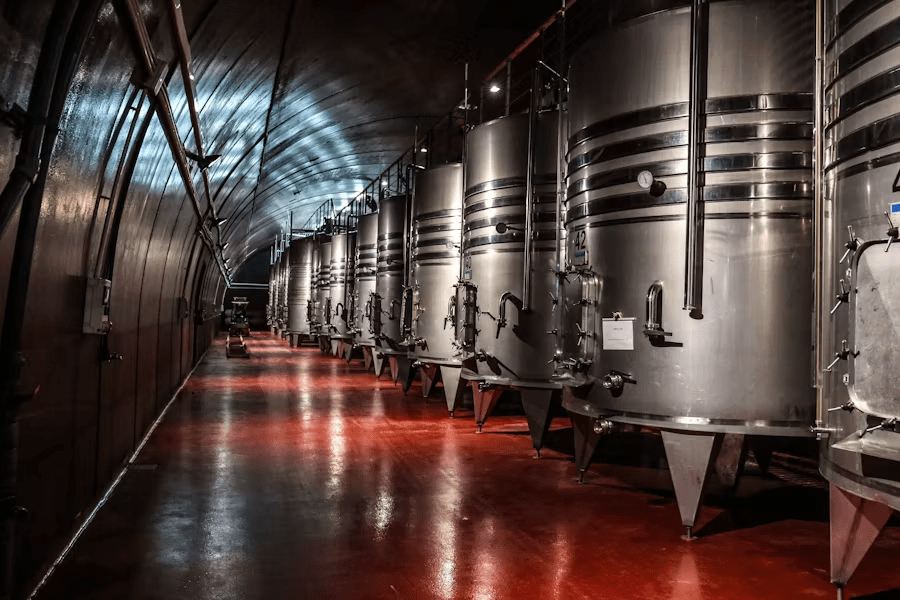
According to Forbes, AI applied to wine is helping producers better understand what consumers actually perceive in the glass. But to close that loop — from vineyard to glass — models also need to understand what happened inside the winery. And that is only possible if fermentation leaves as rich a data trail as the vineyard already does.
The International Organisation of Vine and Wine (OIV) estimates that global wine production exceeds 260 million hectolitres a year. Within that volume, fermentation variability isn’t an exception — it’s the norm. Capturing it means capturing one of the main sources of quality variation between vintages and between wineries.
Enobot: The Infrastructure That Closes the Data Loop
Enobot is not an AI that makes wine for you. It doesn’t replace the winemaker, and it doesn’t make autonomous decisions about your process. Its function is more precise — and more valuable — than that: to capture the fermentation data that has, until now, been lost, structure it continuously and comparably, and make it available to the winery so it can be integrated into any data ecosystem or analytics platform.
The Enobot system is installed directly in fermentation tanks without affecting the process, using food-grade certified sensors fitted magnetically. It records density, temperature and fermentative kinetics in real time, 24 hours a day, throughout the entire harvest campaign. Data syncs to the cloud and is accessible from any device.
After a season or two, the result isn’t just an operational control tool. It becomes a historical data asset that describes, at hourly resolution, how every tank, every variety, every batch fermented — under what conditions, with what interventions, with what outcome.
That asset is exactly what AI models need in order to learn from a winery’s own vintages: not generic industry data, but each producer’s specific fermentation history, comparable season after season.
The Future: Wineries That Learn From Themselves
As a recent industry analysis in Time for Wine points out, the next wave of AI in wine is about integration: vineyard, winery and market connected in feedback loops that let producers learn and improve systematically. Projects like PENVITIS+ in Ribeira Sacra, Sensing4Farming in Ribera del Duero, or Concha y Toro’s drone programme in Chile show that this integration is already happening in the vineyard — across very different wine regions of the world. The next logical step is for it to happen inside the winery too.
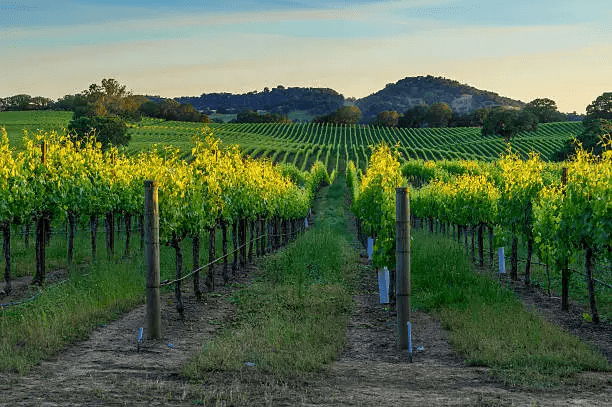
Fermentation is the link that has been missing from that chain. Not because the data didn’t exist — it has existed for as long as yeast has — but because, until recently, there was no practical way to capture it continuously, in a structured way, and at the scale of multiple tanks simultaneously.
The vineyard already speaks. The climate already speaks. With Enobot, fermentation can speak too.
Conclusion
Artificial intelligence applied to wine is only as good as the data that feeds it. Wineries from Ribera del Duero to Tuscany to the Maipo Valley have shown the value of structuring vineyard data well. But models trained exclusively on external data have a clear ceiling: they cannot see what happens inside the tank. Bringing fermentation data — density, temperature, kinetics, events — into the mix isn’t a marginal improvement. It’s the difference between a model that predicts a grape’s potential and a model that understands why a vintage turned out the way it did.
Want to start capturing your winery’s fermentation data? Discover how Enobot, Komsenso’s real-time fermentation monitoring system, works.