
By Komsenso · Real-time fermentation monitoring
Why should we have Enobot?
The first question we are often asked when we visit a winery for the first time is: why should we have Enobot? The considerable savings in direct costs, the increase in precision, and the fact that greater consistency has helped our longest-standing customers raise the prices of their wines by up to 30%, are simply the result of having fewer incidents. Here we share the most typical faults we have come across, which tend to recur, along with an incident at a customer in Chile that reminds us how monitoring often detects faults and problems we would never have imagined.
Winemakers have been controlling fermentation for decades with thermometers, hydrometers and the experience accumulated over many harvests, and in most cases that know-how works.
But sensing with Enobot is not here to replace the winemaker. It is here to tell them what happens between one sample and the next — things no one would otherwise have caught in time — and to store the data from every vintage, so you can analyse in detail what went well and what can be improved year after year.
In this article we share five real situations that tend to recur harvest after harvest, detected in wineries across different appellations of origin and countries. Fermentation problems know nothing of geography, wine colour or tank size.
Data that powers artificial intelligence
Every finding described in this article is also a structured data point. Accumulated harvest after harvest and tank by tank, real-time fermentation records are the raw material that machine learning and artificial intelligence applied to winemaking models need to anticipate problems, identify quality patterns and optimise the process autonomously. Why is fermentation the missing link of AI in wine? →
1. The tank that would not start — and no one knew why
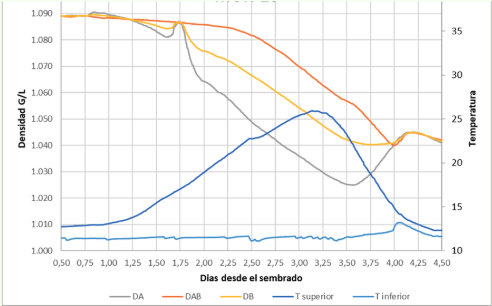
One of the most serious and recurring problems we have detected in whites over these years is stratification. Two years ago, at a winery specialising in white wines in the Rueda area, we had spent two days watching a tank of must fail to start fermenting. The temperature was correct and the yeast had been added according to protocol. There are usually other indicators that show something is wrong, but in this particular case everything seemed in order.
Enobot’s density curves showed something the eye cannot see: the must was stratified. The upper fraction, colder and less dense, formed an isolated layer that prevented the yeast from distributing evenly throughout the tank. Fermentative activity existed — but it was confined to a narrow band, unable to progress.
The real risk
A stalled must is an exposed must. In the absence of active alcoholic activity, acetic and lactic bacteria find favourable conditions to proliferate, which can lead to high volatile acidity or the complete loss of the tank. As Bisson’s landmark review sets out (Stuck and Sluggish Fermentations, American Journal of Enology and Viticulture, 1999), the premature arrest of fermentation is one of the most challenging problems in winemaking to diagnose and correct: its causes are numerous and, once it is under way, the window to act narrows sharply.
With that information, the winemaker applied a gentle pump-over and the process started normally. Without the real-time curve, the intervention would have come too late — once the symptoms were already visible and the window for correction far narrower.
Want to understand how Enobot interprets density curves? See our FAQ section.
2. The cooling failure spotted from home
It was the dead of night during harvest. The winemaker was no longer at the winery when Enobot’s alarm system recorded a sustained deviation in one of the tanks: the temperature curve, which should stay stable between 14 and 16°C to preserve varietal aromas, was starting to rise steadily.
The winemaker received the alert on their phone, reviewed the curves and urgently called our team to confirm the reading — it was their first season using Enobot. After checking the data together there was no doubt: the cooling unit had failed. The on-call cellar manager was contacted, reactivated the system, and the problem was resolved before the temperature reached the critical threshold.
The real risk
Fermentation temperature is one of the most decisive parameters for white wine quality. Above 20°C (this can shift by a few degrees depending on the variety) yeast activity accelerates uncontrollably, producing volatile esters that mask varietal aromas. The Handbook of Enology by Ribéreau-Gayon et al. (Wiley, 2006) documents that temperatures above certain ranges during white-wine fermentation cause quantifiable, irreversible losses of primary aromas. These temperatures vary widely by region, but every white wine has a limit — and with climate change the upper limit is being exceeded more and more frequently, as we are seeing in the 2026 harvest. Studies on the influence of fermentation temperature (Molina et al., Applied Microbiology and Biotechnology, 2007) confirm that temperature directly governs the synthesis of volatile compounds by the yeast, which makes thermal control a fundamental quality criterion, especially for premium wines.
In wineries with premium wines, a temperature-driven runaway fermentation can compromise the entire harvest in that tank. In entry-level wines the impact is smaller, but the quality risk still affects the consistency of the vintage.
See how Enobot’s alert system works →
3. The leak no one had seen
This finding comes from one of our customers in Chile — and it is perhaps the one that surprised us most, because wineries usually assume that a visual check of the tanks is enough to spot volume losses.
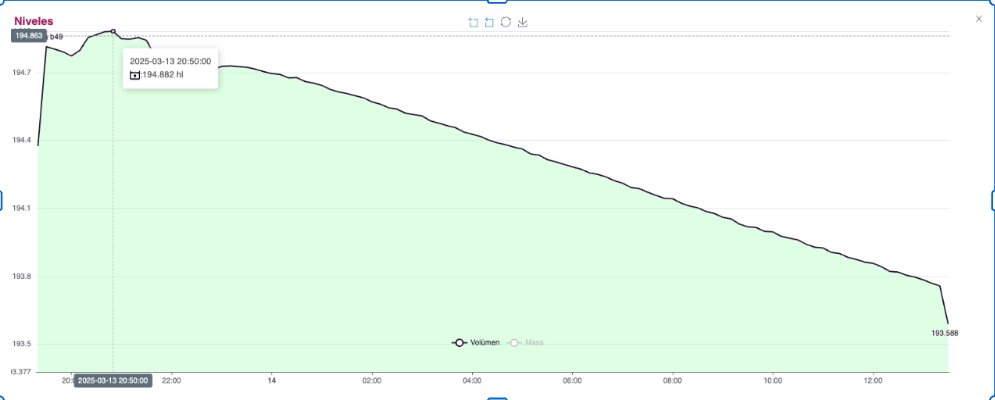
While tracking a tank’s level, Enobot detected a progressive volume loss that matched neither evaporation nor any documented extraction. We notified the winery, but the team initially dismissed the alert, as they found no leak visible from the outside of the tank.
An active leak of more than 7 litres per hour is practically invisible in a standard visual inspection, especially in large-capacity tanks and in wineries with dozens of active tanks. In this case, the liquid drained straight into the tank’s outlet — of small cross-section — without producing any noticeable spill around the tank. Accumulated over a fermentation of 10 to 14 days, that leak represented more than 2,000 litres of high-value wine lost, on top of the contamination risk and the progressively worsening loss.
Twelve hours after the first alert, as the anomaly persisted in the data, we escalated the issue and called the head winemaker directly for an in-depth review. The leak was located after an inspection and repaired. Had it gone unidentified, the financial loss would have run into tens of thousands of dollars, since in the latest readings the 7 litres per hour had begun to increase.
4. The curve that gave away a dosing error
An external winemaker — a consultant who works with several wineries in Castilla y León and uses Enobot as a remote monitoring tool — recorded an anomaly in the kinetic curve of one of the tanks under his supervision: the fermentation speed was significantly lower than that of neighbouring tanks with similar must, temperature and inoculum profiles.
After reviewing the operations log, the diagnosis was clear: the operator had added the nutrient dose to the wrong tank, depriving this batch of the input it needed at the most critical moment of the fermentation start.
The real risk
Nitrogen nutrition at the right moment is decisive for a complete, clean fermentation. A severe deficiency of assimilable nitrogen can cause a slow or stuck fermentation, or the production of sulfur compounds (H₂S), compromising the wine’s aromatic profile. Human errors do not disappear with more staff or more training — they are detected and corrected with systems that record what happens continuously and impartially.
As a result of this type of incident, in 2026 we have implemented, together with specialised partners, systems for automated nutrient dosing based on real-time fermentation parameters, removing the dependence on manual intervention at critical moments. Contact us if you would like to know more about these solutions.
More information about the Enobot platform →
5. The must that breathed too early
At a winery in the DO Rueda, Enobot detected a spike in CO₂ activity in tank #07, which held freshly pressed Verdejo must that had not yet been settled (débourbage). According to the production plan, that tank was not due to begin fermenting until the following day.
The spontaneous bubbling indicated that native vineyard yeasts — naturally present in any freshly pressed must — had started fermentation earlier than planned.
The real risk
A white must that ferments before settling runs a significant risk: the suspended solids can generate sulfur compounds with cabbage, garlic or rubber odours — defects that are hard to remove in later stages. The Australian Wine Research Institute (AWRI) has documented that musts with higher solids and turbidity tend to develop volatile sulfur compounds and reductive characters. Reference studies on wine yeasts warn that uncontrolled starts can result in unpredictable aromatic profiles across tanks from the same batch (Fleet, 2003).
Tank #07 was part of a series of twelve tanks from the same batch. Letting that lot ferment under different conditions from the rest would have compromised the consistency of the final cuvée.
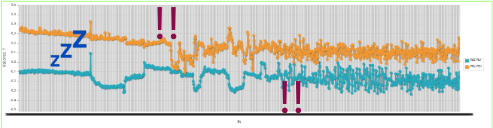
The intervention: having detected the bubbling early, the team acted immediately — they moved the must to a cold tank to slow yeast activity, applied mechanical clarification and brought the native yeasts under control. The next day, with the must stabilised, the planned commercial strain was inoculated and fermentation followed its normal course.
Subsequent analyses confirmed that no off-odour compounds had formed. Without the sensor’s alert, the incident would not have been detected until the manual check the next morning — ten hours of uncontrolled fermentation on the lees, which would have developed an aromatic profile different from the rest of the batch.
See our FAQ section to understand how Enobot detects this kind of anomaly in real time.
These are just a few examples of common incidents that have struck us, but every harvest we find at least one incident for every 10 tanks. Want to see more examples of what Enobot can detect? Explore our success stories →
What these five cases have in common
None of these findings required the winemaker to be at the winery at the exact moment the problem occurred. In most cases they would have gone unnoticed in routine laboratory analyses. And in every one of them, the window of time to intervene without serious consequences was measured in hours, not days.
Sensing with Enobot does not change the winemaker’s job. It changes when they get the information: from hours or days later, to real time. That difference is not cosmetic — it is the difference between managing a process and reacting to its consequences.
Enobot as infrastructure for AI in the winery
The five cases described here illustrate the immediate value of real-time data. But there is a second, equally strategic dimension: the fermentation history Enobot accumulates harvest after harvest becomes the structured dataset that artificial intelligence and predictive analytics systems need to identify the patterns that determine each vintage’s quality, anticipate deviations before they happen and enable intelligent automation of the winemaking process. According to Forbes, machine-learning models applied to wine already help us understand what consumers perceive in the glass — but to close that loop from vineyard to market, the models also need to understand what happened during fermentation. Enobot is the data layer that makes it possible. Read: Why fermentation is the missing link of AI in wine →
If you would like to better understand how the platform works, see our FAQ section, check how Enobot works step by step, or explore more success stories.
What could Enobot detect in your winery?
Every winery is different — the tanks, the staff, the protocols, the varieties. But the risks described here are common to any winery that ferments at scale: stratification, temperature failures, premature starts, dosing errors, leaks.
If you would like to know how Enobot would work in your facility, we can start with a conversation. Discover how Enobot, Komsenso’s real-time fermentation monitoring system, works, or contact us directly.
Komsenso develops Enobot, the IIoT sensing platform for fermentation control in wineries. Currently deployed in more than 30 wineries across several Spanish appellations of origin.
References
Australian Wine Research Institute (AWRI). Winemaking treatment – varying grape solids in white wine fermentation. AWRI Winemaking Resources.
Bisson, L.F. Stuck and Sluggish Fermentations. American Journal of Enology and Viticulture, 50(1), 107–119 (1999).
Fleet, G.H. Yeast interactions and wine flavour. International Journal of Food Microbiology, 86(1-2), 11–22 (2003).
Forbes. How AI helps winemakers understand what people taste. Barth, J. (2024).
Molina, A.M. et al. Influence of wine fermentation temperature on the synthesis of yeast-derived volatile aroma compounds. Applied Microbiology and Biotechnology, 77, 675–687 (2007).
Ribéreau-Gayon, P. et al. Handbook of Enology, Vol. 1: The Microbiology of Wine and Vinifications. Wiley, 2006.