
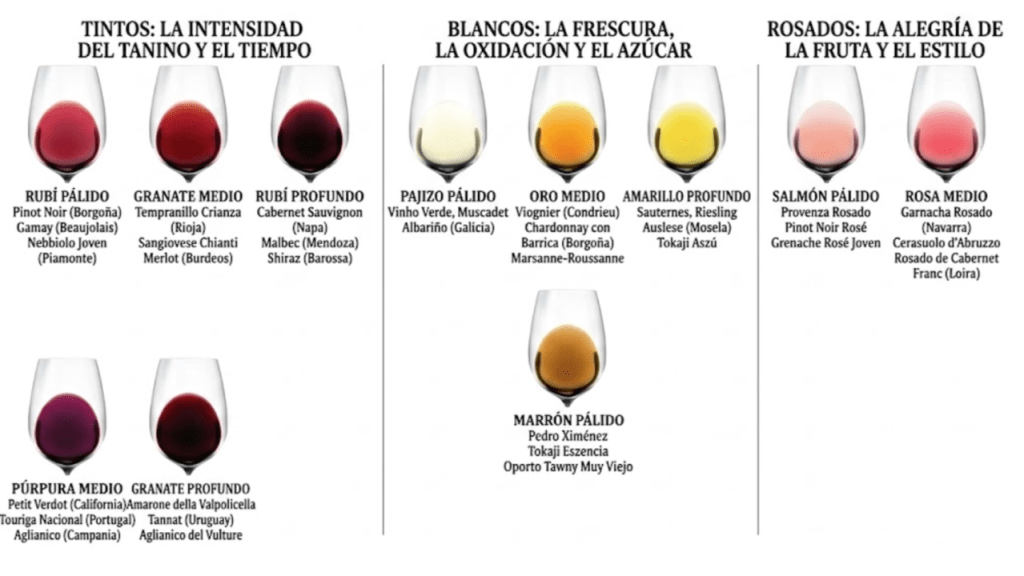
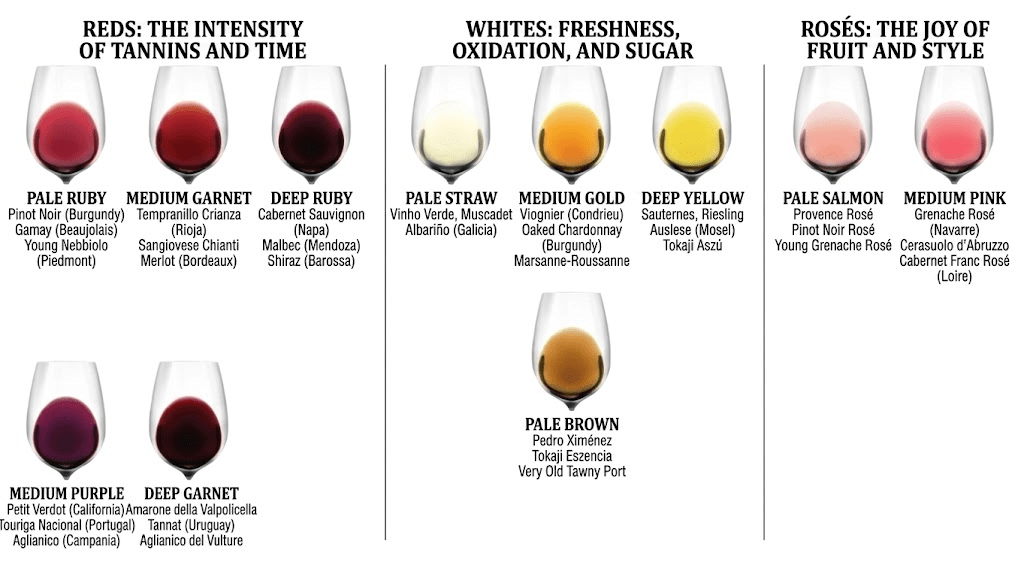
If you squeeze a red grape, the liquid that comes out is white. What happens next is what decides everything.
If you’ve ever wondered how the exact same red grape can end up as a crystal-clear white, a pale rosé, or a structured red wine, the answer isn’t just in the fruit—it’s in the time and the technique.
The juice of almost all red grapes is colorless. If you squeeze a red grape, the liquid that comes out is white.
The color, tannins, and structure aren’t found in the pulp; they are in the hollejo (the grape skins). From that point on, the winemaker’s job is to decide how long to let the juice “coexist” with its skins. This technical process is called maceration, and it is what ultimately decides the chromatic destiny of your glass.
🍷 Red Wine: Skin fermentation for 1–3 weeks
The must ferments in direct contact with the skins, seeds, and stems. This coexistence is what builds deep color and complexity. The carbon dioxide naturally pushes the solids to the top, forming the “cap” (sombrero)—an area extremely rich in anthocyanins (color) and tannins (structure).
🥂 White Wine: Immediate pressing, zero skin contact
Slow fermentation takes place at 12–16°C to preserve primary aromas and brightness. If red grapes are used and the skins are removed immediately, you get a “Blanc de Noirs”—the best-kept secret behind many exceptional sparkling wines.
🌸 Rosé Wine: Skin contact for just a few hours
Following a brief maceration, the “saignée” (bleeding) method is used: the pink juice is drawn off by gravity and ferments at a low temperature, just like a white wine. This creates everything from pale, Provence-style tones to the more vibrant, vivid rosés typical of regions like Navarra.
¿Qué ocurre exactamente durante la maceración como parte del proceso de fermentación?
Color extraction is neither instantaneous nor linear. Anthocyanins—the pigments responsible for the color in red wine—begin to be released within the first few hours of skin contact, but their long-term stability depends entirely on their bond with tannins. Without tannins, the color fades over time. Without color, the tannins feel aggressive and lack structural support.
Temperature is the other major variable.
- At 20–30°C: Extraction is fast and intense.
- Below 15°C: The process slows down, favoring aroma retention over heavy structure.
This is exactly why white wines are cold-fermented: there is zero interest in extracting anything from the skin; the sole focus is protecting the most volatile aromatic compounds.
The “cap” (sombrero)—that solid layer of grape skins floating on top of the fermenting juice—concentrates the vast majority of available anthocyanins. Because of this, how a winemaker manages the cap directly shapes the final wine’s color and tannin profile:
- Pump-overs
- Rack-and-return
- Punching down (pigeage)
More contact means more extraction and power. Less contact results in greater elegance and freshness.
Traditionally, managing this maceration process relied purely on the winemaker’s intuition, experience, and occasional lab analysis.
Today, real-time sensing—tracking temperature, density, $CO_2$ ratios, liquid levels, and turbulence—allows for the continuous monitoring of a tank’s evolution.
The result is not just greater control, but a deeper understanding of extraction: knowing not only how much is extracted, but exactly when and how. Fermentation shifts from an art guided solely by intuition to an increasingly measurable, precise, and reproducible discipline.
From the dinner table, we only see the final result: color, aroma, texture, and acidity. But behind every bottle lies a sequence of critical decisions—skin-contact time, temperature, and fermentation duration—that ultimately define what ends up in the glass.
Data-Driven Winemaking with Enobot
Enobot’s real-time sensing technology continuously tracks density, temperature, and fermentation kinetics, translating raw data into actionable insights:
- Instant Visibility: Know exactly which tanks are progressing perfectly and which ones are deviating.
- Risk Prevention: Detect early signs of issues like stratification or stuck fermentations before they become costly problems.
- Vintage Repeatability: Everything is logged, harvest after harvest, so you can pinpoint exactly why a specific vintage turned out exceptional—and replicate it.
Additionally, by generating historical data for every single tank year after year, it empowers the winemaking team to analyze the evolution of each vintage in detail and map it directly against the final profile of the wine.
Would you like to learn more about our solutions to better control your fermentation process for red, white, or rosé wines?
If you’re interested in learning more about how we’re helping wineries of all sizes better monitor their fermentations, you can email us directly at [email protected]m or reach out through our website with any questions regarding real-time sensing in the winemaking process.
#Winemaking #Fermentation #WineIndustry #WineTech #AgTech #WineryInnovation #SmartWinemaking #Enobot #Komsenso #RedWine #WhiteWine #RoseWine